
Laser, plasma or waterjet: what happens to your file
Updated: Jul 30, 20265 min read
The three common cutting processes compared: accuracy, materials, edge quality — and what it all means for your DXF file.
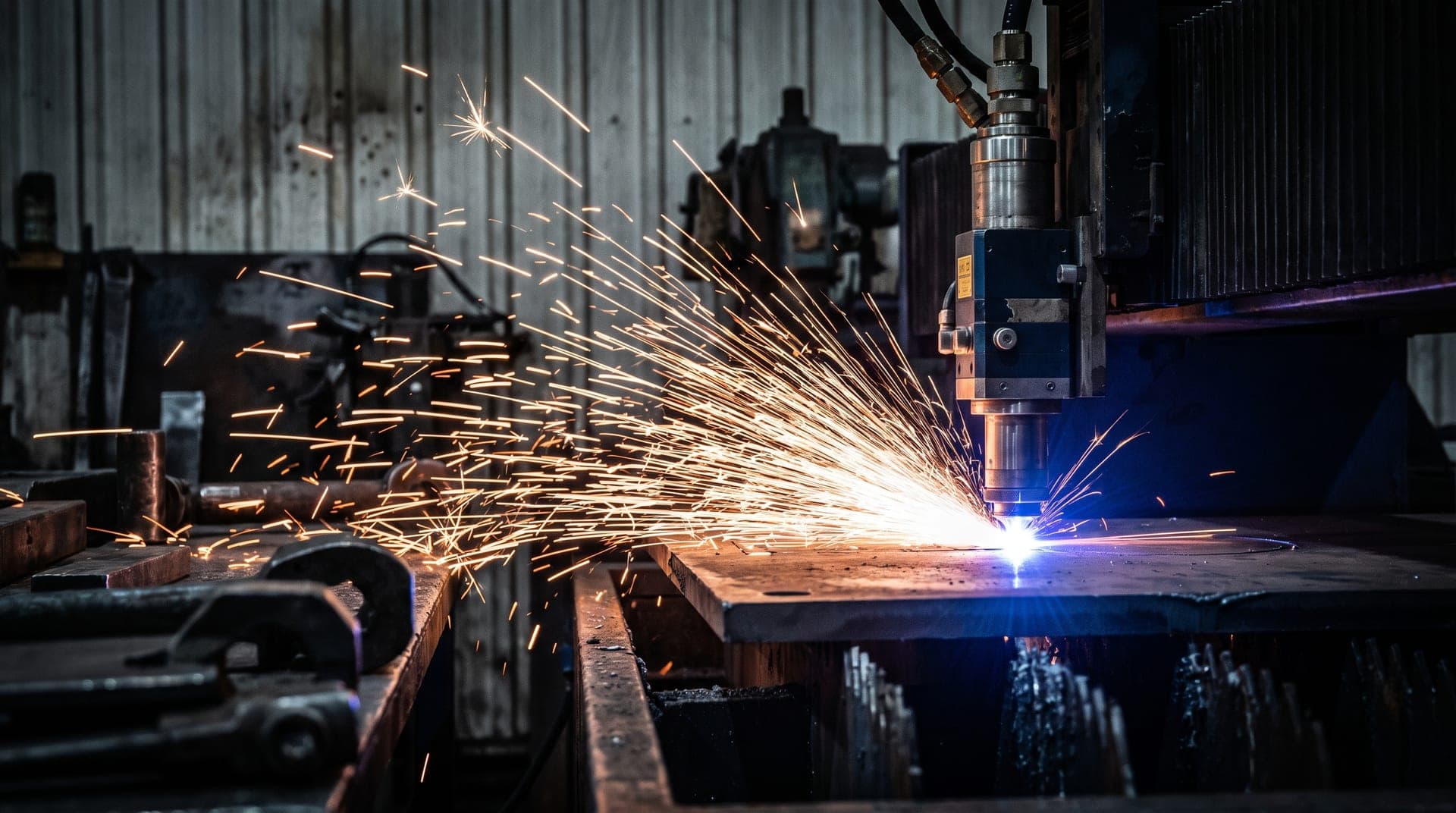
Once a DXF is finished, the part you rarely get to see as a client begins: the drawing becomes a tool path and a machine separates a part from the sheet. Which process is used influences accuracy, edge quality, price — and, within limits, how the file ought to look.
What all the processes share
All three work on the same basic principle: a tool travels along a path and separates material as it goes. The path comes from your file, the rest is physics. And all three remove material at a certain width — the kerf — which the controller compensates for by offsetting the tool path.
Common to all as well: they need closed contours. A controller has to know which side is the part and which the offcut in order to offset in the right direction. An open polyline leaves that question unanswered.
Laser cutting
A tightly focused beam of light heats the material at a very small spot until it melts or vaporises; a gas jet blows the melt out of the kerf. Because the focal spot is tiny, the kerf is narrow — often only one or two tenths of a millimetre.
That makes the laser the most accurate of the three. Fine contours, small holes and narrow webs are possible, and the edge is smooth and usually usable without rework. The heat-affected zone — the region beside the cut edge whose structure is altered by the heat — is narrow but present.
Limits: highly reflective materials such as copper and brass are more demanding. There is a ceiling on material thickness. And on very delicate parts the heat introduced can cause distortion — the thinner the material and the closer the contours sit together, the more likely it becomes.
Plasma cutting
An electrically conductive gas is heated to several tens of thousands of degrees and melts the material, which is then blown out. The process works only on conductive materials, that is on metals.
Plasma is fast and, on thicker plate, more economical than the laser. In exchange the kerf is considerably wider, the edge stands slightly off square — the so-called bevel angle — and the heat-affected zone is larger. For brackets, mounts and structural steel parts where tenths do not matter, it is the pragmatic choice.
For the file that means very small holes make no sense. As a rule of thumb a hole should be no smaller than the material is thick — below that the edge turns ragged or the hole partly closes again as it solidifies.
Waterjet cutting
A very fine jet of water at extremely high pressure, usually with an abrasive additive, erodes the material. Nothing is melted, it is worn away — and that is the decisive advantage: no appreciable heat is generated.
So there is no heat-affected zone, no distortion and no change to the material structure. The process cuts almost anything: metals, stone, glass, ceramics, composites, rubber, foam. Large thicknesses are possible too.
The price for that is speed: waterjet is considerably slower and, depending on material, dearer. The kerf widens slightly towards the bottom as the jet loses energy, and on very delicate contours the process suits less well than the laser.
| Laser | Plasma | Waterjet | |
|---|---|---|---|
| Accuracy | very high | moderate | high |
| Kerf | very narrow | wide | narrow |
| Heat input | low | high | virtually none |
| Materials | metals, plastics, wood | conductive metals only | almost anything |
| Speed | high | very high | low |
| Typical for | fine parts, clean edges | thick plate, structural steel | sensitive and thick materials |
What this means for your file
The good news: you do not need to know the process to supply a usable template. Adapting to the machine is the shop's job. A few points are relevant across all processes, though, and can be taken into account in the template:
- Avoid holes that are too small. As a rough rule the diameter should be at least the material thickness.
- Do not make webs too narrow. A very thin web between two cut-outs distorts under heat or breaks.
- Give internal corners a small radius. No round tool can produce a perfectly sharp internal corner; a radius is there anyway, and if it is drawn, it is under control.
- Say so if edge quality matters, for instance because the part stays visible or will be painted.
After cutting
A freshly cut part is rarely finished straight away. Depending on the process a burr remains on the underside and has to be removed — more with plasma, less with laser, hardly any with waterjet. On steel there is scale on top of that, an oxide layer on the cut edge.
Where a part is later painted, powder-coated or otherwise processed, finishing is part of the effort and should be discussed from the outset. Here too, knowing the purpose helps: a part that disappears inside an enclosure needs no deburred visible edge.
Why the layout on the sheet matters
Before cutting, work preparation arranges all the parts on the material sheet — this is called nesting. The aim is to generate as little offcut as possible, because what is normally paid for is the area occupied, not the bare outline of the part.
That has two practical consequences for you. First, it pays to order several parts together rather than one after another: they then share a sheet and the setup effort. Second, a small change to the outline can noticeably lower the price if it lets more parts fit on a sheet. If you have room to move on an edge, that is worth mentioning.
With sheet that has a rolling direction or a brushed finish, orientation is not arbitrary either. If the grain direction stays visible on your part, say so — it cannot be corrected afterwards.
Frequently asked questions
Do I need to know which process is used?
No. The shop chooses based on material, thickness, quantity and accuracy requirement. All that is useful is for you to say what matters to you about the part.
Why are my internal corners not sharp?
Every cutting tool has a width and cannot produce a mathematically sharp internal corner. A small radius always results. Draw it yourself and you keep control of its size.
Will my part distort during cutting?
With laser and plasma, heat can cause distortion, particularly on thin material with contours close together. Waterjet introduces virtually no heat and is the safer choice in such cases.
Is laser cutting always the best choice?
No. On thick structural steel plate plasma is more economical, and for heat-sensitive or non-conductive materials there is no way around waterjet.
More articles
Got a template and need a DXF?
Upload a sketch, photo or PDF. You receive a fixed-price quote up front, no obligation, no account fees.
Start a request